

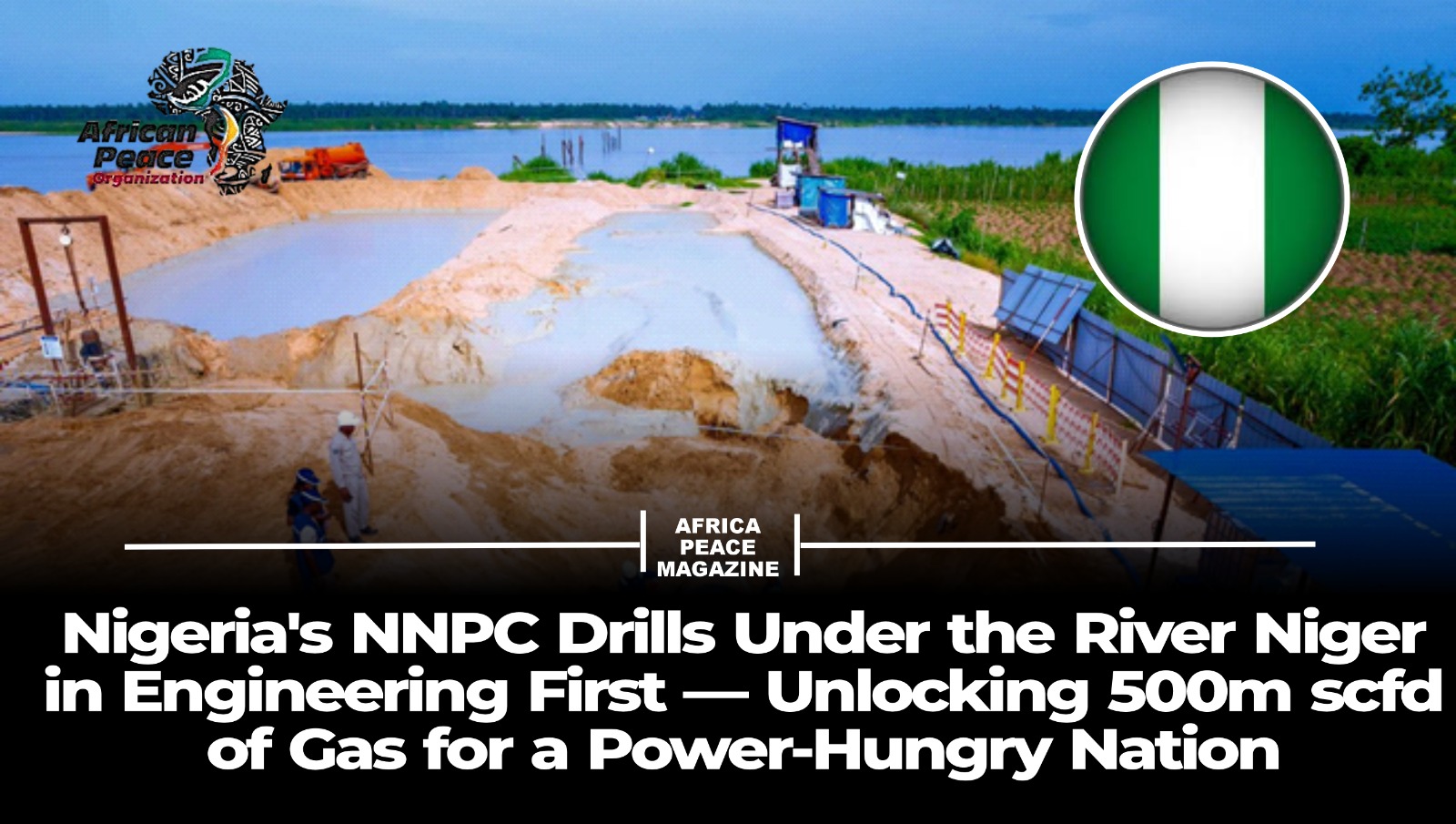
The Nigerian National Petroleum Company Limited has completed one of the most technically demanding feats in the country’s energy history — drilling approximately two kilometres beneath the River Niger to complete the long-stalled crossing of the Obiafu-Obrikom-Oben gas pipeline, a breakthrough that activates the full capacity of a 130-kilometre artery at the heart of Nigeria’s gas transmission network.
The crossing was executed by NNPC Gas Infrastructure Company, a wholly owned NNPC subsidiary, using advanced horizontal directional drilling technology — a method reserved for some of the world’s most complex subsurface engineering challenges. The OB3 pipeline is designed to transport up to two billion standard cubic feet of gas per day, and its full activation is now expected to unlock over 500 million standard cubic feet of additional daily gas supply to the domestic market in the near term, with cascading benefits for electricity generation, manufacturing, and potential exports to West African neighbours.
NNPC Group Chief Executive Officer Bayo Ojulari called the crossing a defining moment for Nigeria’s gas infrastructure ambitions. “The completion of the OB3 River Niger Crossing is a defining milestone for Nigeria’s gas infrastructure and a clear demonstration of what disciplined execution and sustained commitment to excellence can deliver. By successfully traversing one of the most technically challenging sections of the project, we have unlocked a critical link that will enhance gas supply reliability, deepen domestic utilisation, and support power generation and industrial growth across the country,” he said.
Ojulari linked the achievement to engineering lessons drawn from the earlier River Niger crossing on the Ajaokuta-Kaduna-Kano pipeline, completed in 2025, describing the OB3 success as a deliberate scaling of that experience. He also tied the milestone to the Federal Government’s broader energy targets — including raising crude oil production to three million barrels per day and gas output to 12 billion standard cubic feet per day by 2030. “The successful River Niger Crossing ensures that Nigeria’s gas-producing regions are now physically interconnected with the rest of the country, a critical requirement for achieving our long-term production and supply aspirations,” he said.
The OB3 pipeline has for years been regarded as the backbone of Nigeria’s gas master plan, linking eastern gas fields to western demand centres and feeding further into the northern corridor through the AKK pipeline. The River Niger crossing had been the single most intractable bottleneck — its geological and environmental complexity in the Niger Delta region had repeatedly frustrated completion and left significant installed power generation capacity underutilised. With the crossing now resolved, industry analysts say Nigeria is closer than ever to operating a fully integrated national gas grid capable of reducing flaring, boosting domestic gas use, and positioning the country as a genuine regional gas hub.
Source: Punch Nigeria