

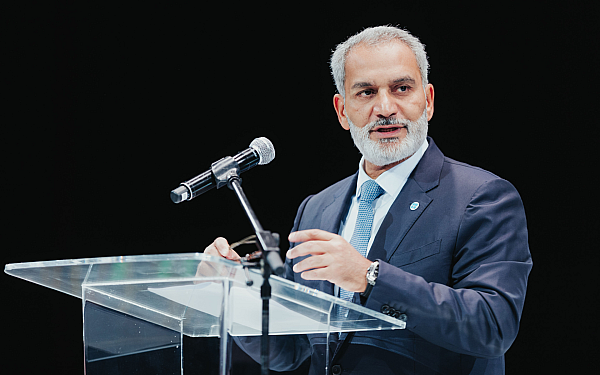
OPEC Secretary General Haitham Al Ghais will address African Energy Week (AEW) 2026 in Cape Town, bringing one of the most influential voices in global oil governance into direct engagement with Africa’s leading producers, investors and policymakers.
His participation comes as global oil markets continue to adjust to evolving geopolitical dynamics, OPEC+ supply management decisions and shifting demand patterns across emerging economies. With spare capacity closely managed and production discipline remaining a central feature of market coordination, OPEC continues to play a stabilizing role in global energy markets.
OPEC+ – which accounts for roughly 45% of global crude oil supply – has maintained a cautious production approach into 2026, prioritizing market stability alongside broader considerations of global demand trends and economic growth trajectories. At the same time, energy security has returned to the forefront of policy discussions across both producing and consuming countries, reinforcing the importance of predictable and well-coordinated supply frameworks.
Within this environment, Africa remains structurally important to OPEC’s evolving outlook. The continent is home to key member states including Nigeria, the Republic of Congo, Equatorial Guinea, Algeria, Gabon and Libya, each playing a distinct role in the organization’s broader production and investment framework.
Nigeria, OPEC’s largest African producer, continues to pursue upstream reforms under the Petroleum Industry Act, alongside efforts to revitalize key assets such as the Niger Delta Joint Venture portfolio and deepwater developments like Bonga North, aimed at stabilizing output and improving investment conditions after years of volatility.
The Republic of Congo is steadily expanding offshore production through developments in the Moho Nord extension and Marine XII projects in partnership with international operators, while Equatorial Guinea is advancing LNG and gas monetization anchored by the Punta Europa LNG complex and the Gas Mega Hub strategy.
In Libya, production recovery efforts continue around key fields in the Sirte Basin as operators work to restore output stability, while Algeria is maintaining investment momentum through gas developments led by Sonatrach, particularly around its Hassi R’Mel expansion and LNG export infrastructure. Gabon, meanwhile, is focusing on sustaining offshore production through redevelopment of mature fields and broader partnerships aimed at improving recovery rates and extending asset life.
“Africa is not operating at the margins of global energy markets – it is central to their stability, resilience and future balance,” said NJ Ayuk, Executive Chairman of the African Energy Chamber. “Having Secretary General Haitham Al Ghais at African Energy Week reflects the reality that today’s energy challenges cannot be solved without Africa at the table, shaping the conversation on supply, investment and long-term security.”
OPEC’s medium-term outlook into 2026–2027 continues to emphasize the need for sustained upstream investment to offset natural field decline and ensure long-term supply adequacy. While oil demand growth is increasingly concentrated in Asia and emerging markets, Africa’s role as both a producing region and a demand growth frontier is becoming more pronounced in global energy forecasts.
The organization is also placing greater emphasis on the role of gas and integrated energy systems in supporting long-term energy security. This aligns with Africa’s own LNG expansion trajectory, with major developments underway in Mozambique, Mauritania-Senegal and across West and North Africa, where new projects are gradually reshaping the continent’s export capacity.
At AEW 2026, Al Ghais is expected to engage in high-level discussions around market stability, investment requirements and Africa’s long-term production outlook, as global producers seek to balance security of supply with capital discipline in a more complex geopolitical environment.
Distributed by APO Group on behalf of African Energy Chamber.