

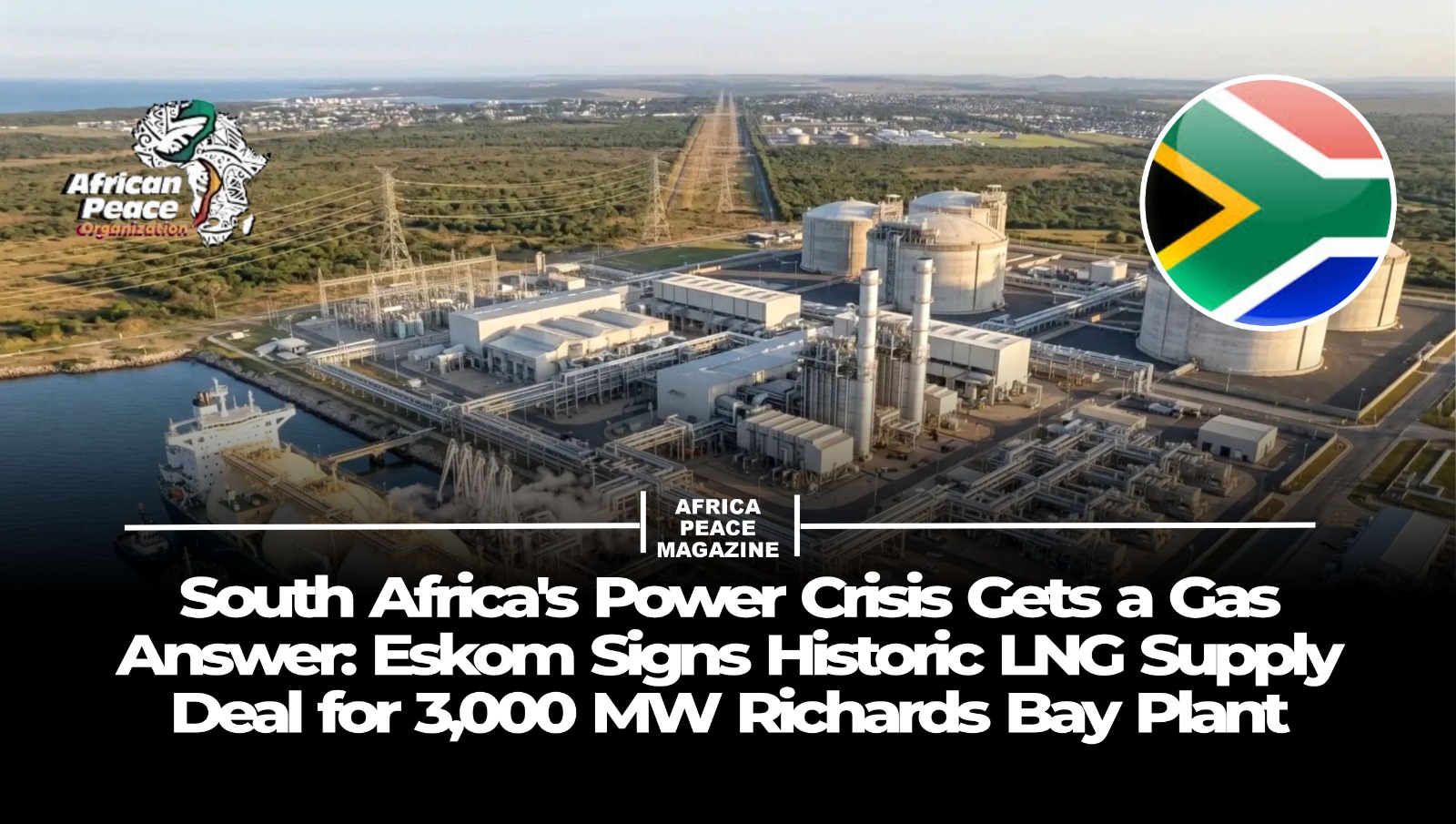
South Africa has taken a decisive step toward ending its decade-long electricity crisis, with state utility Eskom signing a landmark gas supply agreement with the Zululand Energy Terminal consortium — a deal that establishes the commercial foundation for a 3,000-megawatt gas-fired power generation facility in Richards Bay and positions liquefied natural gas as the anchor transition fuel in the country’s power sector recovery strategy.
The agreement formally installs Eskom as the anchor client of the proposed Zululand LNG import, storage and regasification terminal, providing the off-take certainty that large-scale gas infrastructure requires before it can attract the final investment decisions and international financing that will bring the terminal and the power plant into existence. Without a creditworthy anchor buyer committed to taking gas at scale, the economics of a greenfield LNG terminal in a frontier gas market simply do not close — and Eskom’s signature resolves that fundamental chicken-and-egg problem.
The Zululand Energy Terminal is managed by a consortium comprising Vopak Terminal Durban, Reatile Group Proprietary Limited and Transnet Pipelines. The consortium holds an official concession granted by the Transnet National Ports Authority for the design, construction, operation and maintenance of port offloading facilities in Richards Bay. The 3,000-megawatt power plant will be located in the Richards Bay Industrial Development Zone in KwaZulu-Natal province, operating under a private sector participation framework designed to attract substantial international investment.
Eskom’s Chief Executive Officer, Dan Marokane, made clear that the strategic logic is as much about system architecture as about fuel supply. Gas-fired power, he argued, is indispensable as a transitional bridge: it provides the dispatchable, round-the-clock generation that solar and wind inherently cannot, filling the intermittency gaps that have plagued South Africa’s grid during the long years of load shedding. ‘Gas resources act as an indispensable transitional fuel to support a low-carbon system,’ Marokane said, describing gas-fired plants as specifically designed to complement the variability of renewable sources.
Zululand Energy Terminal Director Oliver Naidu reinforced the near-term commercial roadmap: the consortium expects to advance shortly toward definitive use contracts, final financial close and the commissioning of what would be South Africa’s first LNG import terminal of this kind. The broader policy anchor for the project sits in the country’s Integrated Resource Plan, which mandates the incorporation of 6,000 megawatts of gas-fired generation by 2030, divided equally between independent power producers and Eskom itself.
For South Africa’s industrial heartland in KwaZulu-Natal, the Richards Bay project carries implications that extend beyond electricity supply. A 3,000-megawatt mid-load plant with a projected 25-year operational life, backed by an international LNG supply chain and a private sector participation structure, represents exactly the kind of long-duration anchor investment that can catalyse industrial cluster development — attracting downstream manufacturers, logistics operators and service companies that require reliable, competitively priced power as a precondition for investment.
Source: inspenet.com