

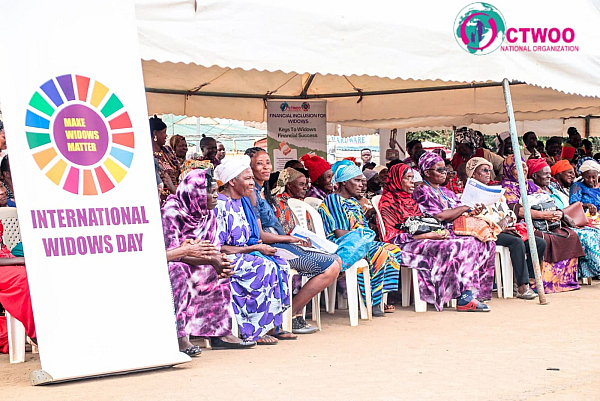
To mark International Widows’ Day, Come Together Widows and Orphans Organization (CTWOO) (http://apo-opa.co/4g1aeOu) and Equality Now (http://apo-opa.co/4fVM73z) (www.EqualityNow.org) are urging MPs in Kenya to pass the Widowed Persons Protection Bill, 2026, before the current parliamentary session ends later this year. Turning this comprehensive Bill into law would provide all widowed persons with long overdue legal protections against the widespread discrimination they, particularly women, routinely face, including disinheritance, confiscation of property, and harmful cultural practices such as widow inheritance and widow cleansing.
The Bill was submitted to Parliament on 12 May 2026 as a Private Member’s Bill sponsored by Hon. Otiende Amollo, MP for Rarieda Constituency, whose commitment to advancing widows’ rights is informed by the discrimination his own mother faced after being widowed.
The Bill was developed and drafted with input from CTWOO and Equality Now, and would transform widowhood from a condition of vulnerability into one of protected status. It aims to ensure widowed persons do not lose their rights, security, dignity, or standing in society.
Kenya’s widows urgently need stronger legal protection
CTWOO provides case support, counselling, and legal education to widows and orphans across Kenya. In May 2026 alone, CTWOO recorded 139 cases, demonstrating the scale of the problem and the lack of effective state channels to address the challenges widows face.
Dr Dianah Kamande, HSC, Executive Director of CTWOO, founded the organisation after experiencing discrimination, dispossession, and blame following the death of her abusive husband.
Drawing on her own experience and years of supporting widows, Dr Kamande saw how legal rights are often inaccessible in practice and undermined by custom, community pressure, and unequal family power dynamics. With little or no say over decisions affecting their lives, widows are routinely subjected to systemic rights violations that are enabled by a fragmented legal framework which leaves critical protection gaps.
Following the death of a spouse, widows are often forced from their homes by family and community members, unlawfully stripped of their possessions, deprived of livelihoods, and denied custody of their children. The resulting dispossession can lead to homelessness, destitution, dependency, and disruption to children’s education.
Widowed persons can face intimidation involving threats, isolation, blame for a spouse’s death, and accusations of witchcraft that are used to justify seizing property. Cyberbullying and fraudulent schemes are emerging and growing problems.
Many communities still subject widows to harmful mourning rites, which may include scarification, coerced fasting, denial of medical care, forced shaving of hair, or being prevented from bathing. Widow cleansing or widow inheritance entails a bereaved wife being pressured into ritual “purification” through forced sexual intercourse, often with a relative, which she is required to undergo before she can continue her life or remarry.
Dr. Kamande explains, “Every week, women come to CTWOO after losing their husbands and then their home, their dignity, sometimes even their children. Kenya’s Widowed Persons Protection Bill draws a clear line between cultural practices that strengthen communities and those causing harm. Culture is not static. It can evolve in ways that acknowledge tradition while ensuring widows are afforded the same dignity, equality, and protection under the law as everyone else.”
The Widowed Persons Protection Bill would strengthen legal protections in Kenya
Equality Now’s report, Gender Inequality in Family Laws in Africa: An Overview of Key Trends in Select Countries (https://apo-opa.co/3QCt9ob), highlights how overlapping and contradictory civil, customary, and religious laws undermine women’s rights across the continent.
Kenya is no exception. Protections for widows are scattered across succession, family, and criminal law. While the Constitution guarantees equality and property rights, the Law of Succession Act, 1981, has provisions that disadvantage widows, including differential treatment in the distribution of agricultural land and the removal of a widow’s right to inherit her late husband’s property if she remarries.
In polygamous marriages, the law groups each wife and her children into a single “unit” for dividing the family estate, giving a widow only a proportion equal to one of her children.
The Bill unites legal protections, creating a single dedicated framework of rights covering equality, dignity, property and inheritance, custody, health, privacy, and digital safety.
The Bill would criminalise coercive mourning rites, widow inheritance, forced marriage, and forced removal of children. It would be a criminal offence to unlawfully seize a widowed person’s property or evict them from the matrimonial home after a spouse dies.
Harassment, falsely accusing a widowed person of causing the death of a spouse, or branding them a witch, would be unlawful, and to address online harassment and inheritance fraud, their right to digital safety would be guaranteed.
The Law of Succession Act would be amended so that widows would be entitled to keep their inheritance if they remarry, and widows in polygamous marriages would inherit in their own right, rather than having their share treated as part of a household unit with their children.
A Widowed Persons Protection Board would be established to coordinate the law’s implementation and improve access to support. The Board would advise on policy reform, investigate rights violations, promote public education, facilitate access to legal aid and counselling, and ensure widows’ rights are reflected in national and county planning.
Data on widowhood is often fragmented and insufficiently disaggregated, making it difficult to design effective responses. The Bill would create a framework for data collection, research, and reporting, with widowed persons recognised as a distinct policy group.
In collaboration with civil society and relevant stakeholders, county governments would set up and maintain emergency shelters for widowed persons made homeless. Counties would be required to allocate adequate resources and establish and support legal aid and justice centres.
Aligning Kenya’s law with the Maputo Protocol and CEDAW
Kenya has ratified the Maputo Protocol (http://apo-opa.co/3QHoUYu), the only regional human rights treaty with a dedicated article on widows’ rights. Article 20 requires African states to protect widows from inhuman or degrading treatment, safeguard their property, and preserve their inheritance rights if they remarry.
As part of the Africa Family Law Network (https://apo-opa.co/4gA3MOn), CTWOO and Equality Now have collaborated with fellow member FIDA-Kenya to ensure the Bill aligns with the Maputo Protocol and the UN Convention on the Elimination of All Forms of Discrimination against Women (CEDAW).
Importantly, the Bill translates Kenya’s commitments into practical, enforceable protections, closing longstanding gaps so widowed persons can fully benefit from the rights guaranteed under national, regional, and international law.
Deborah Nyokabi (https://apo-opa.co/3Qvv3qT), a human rights lawyer with Equality Now, explains, “If enacted, Kenya’s Widowed Persons Protection Bill, 2026, would set a precedent as the first dedicated widowed persons’ rights law in Africa. By addressing legal, social, and economic harms together, it would provide a blueprint for reform in other African countries, where widows face similar discrimination, abuse, and inadequate legal safeguards.
“Kenyan lawmakers can transform commitments under the Maputo Protocol and CEDAW into meaningful protections for widows. Passing the Bill is an opportunity to show that discrimination, dispossession, and harmful practices are not inevitable consequences of widowhood, but rights violations that must be prevented and punished.”
Dr Kamande concludes, “Widowed women are not just survivors; we are leaders, advocates, and agents of change. We have spoken out, organised, documented abuses, and helped develop solutions. We urge MPs to match our efforts by passing the Widowed Persons Protection Bill, 2026, before the current legislative session ends.”
Distributed by APO Group on behalf of Equality Now.
For media enquiries, please contact:
Equality Now:
Tara Carey
[email protected]
WhatsApp + 44 7971556340
Come Together Widows and Orphans Organization (CTWOO):
George Ekokwa
[email protected]
Whatsapp + 254 743 707 046
Social Media:
Equality Now:
Bluesky: equalitynow.bsky.social (http://apo-opa.co/4xICPyl)
Facebook: @equalitynoworg (http://apo-opa.co/4xFwILf)
Instagram: @equalitynoworg (http://apo-opa.co/4oGa1SS)
LinkedIn: Equality Now (http://apo-opa.co/4p2qSQh)
Come Together Widows and Orphans Organization (CTWOO):
Twitter @Cometogether_Wi
About Equality Now:
Equality Now is a worldwide human rights organisation dedicated to securing the legal and systemic change needed to end discrimination against all women and girls. Since its inception in 1992, it has played a role in reforming 120 discriminatory laws globally, positively impacting the lives of hundreds of millions of women and girls, their communities and nations, both now and for generations to come.
Working with partners at national, regional and global levels, Equality Now draws on deep legal expertise and a diverse range of social, political and cultural perspectives to continue to lead the way in steering, shaping and driving the change needed to achieve enduring gender equality, to the benefit of all.
For more details, go to www.EqualityNow.org
About Come Together Widows and Orphans Organization (CTWOO):
CTWOO is a registered non-profit organisation in Kenya, recognised by the NGO Coordination Board in January 2019, having begun as a community-based organisation in October 2013. CTWOO champions the protection of human rights and dignity of widows and their children, in alignment with CEDAW and the Convention on the Rights of the Child. CTWOO is a member of the Global Campaign for Equality in Family Law and an affiliate member of the Africa Family Law Network.
For more details, go to www.ComeTogeWOO.org.