

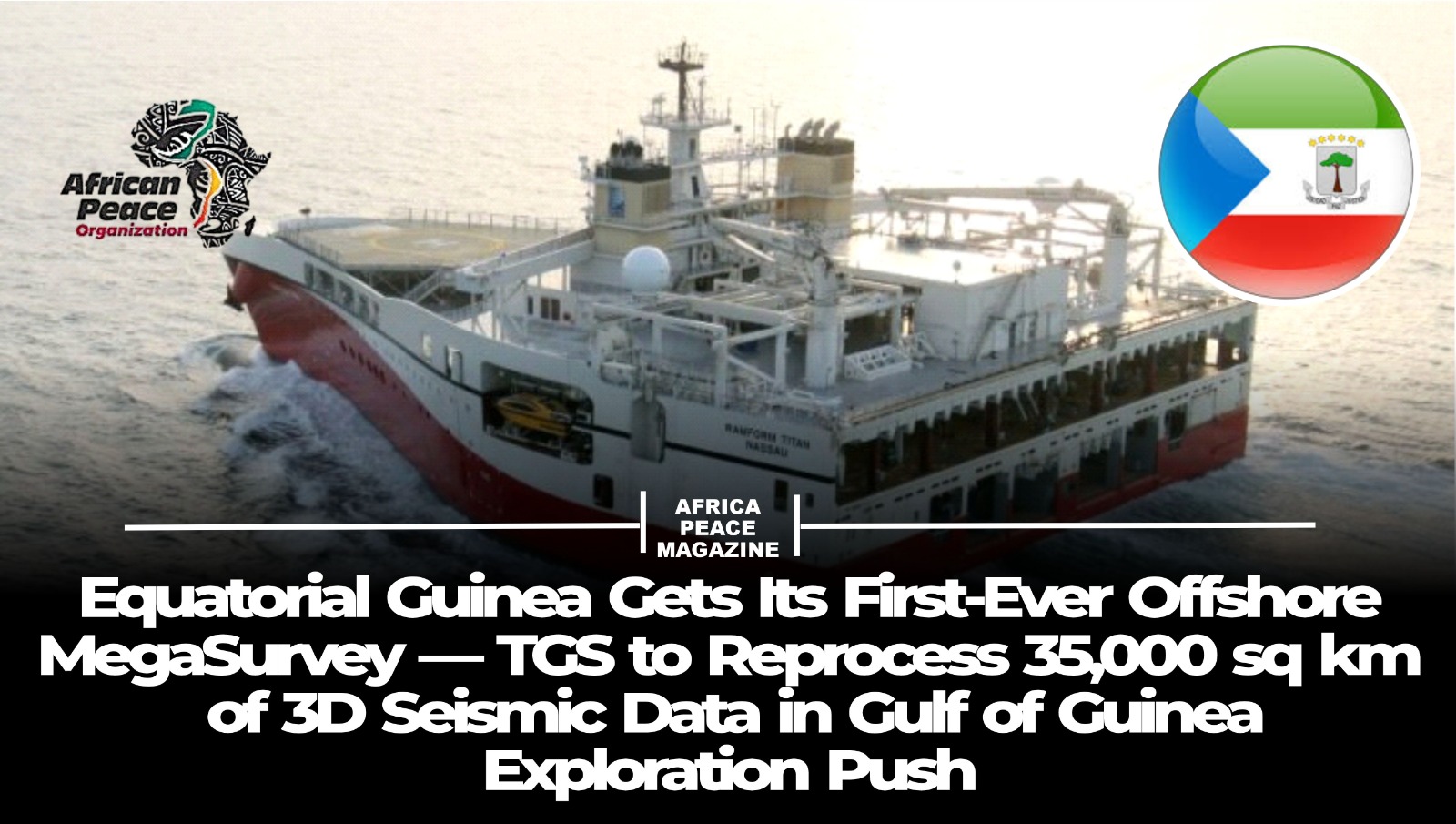
Norwegian energy data and intelligence company TGS has signed an agreement with the Government of Equatorial Guinea to create the country’s first offshore MegaSurvey — a landmark multi-client seismic product that will apply cutting-edge imaging technology across the Rio del Rey and Rio Muni basins and deliver the most comprehensive, regionally harmonised subsurface picture of Equatorial Guinea’s offshore exploration potential ever assembled.
The agreement, signed with the Ministry of Hydrocarbon and Mining Development of the Republic of Equatorial Guinea, initiates a phased programme of seismic data reprocessing and integration that will systematically rebuild the geological picture of the country’s offshore acreage. The first phase alone covers the post-stack reprocessing of approximately 27,273 kilometres of 2D seismic data and around 35,000 square kilometres of 3D seismic data, with completion targeted for Q3 2026.
The full product vision extends considerably further — incorporating approximately 46,343 line kilometres of 2D seismic data and more than 59,000 square kilometres of 3D seismic data into a seamless, basin-wide regional dataset. MegaSurveys, as TGS defines them, are harmonised 3D seismic datasets covering large contiguous areas. They support more confident geological interpretation, improve understanding of structural and stratigraphic frameworks, and help reduce exploration uncertainty — the three variables that most directly determine whether acreage attracts serious drilling interest from international operators.
David Hajovsky, Executive Vice President of Multi-Client at TGS, described the product’s commercial purpose with precision: ‘The Equatorial Guinea MegaSurvey is the first of its kind in the country and will apply TGS’s latest imaging technology to address key subsurface challenges and support exploration risk reduction across the Rio del Rey and Rio Muni basins. The product is designed to provide customers with a basin-wide regional screening tool, supporting prospect identification, prospect ranking and planning for future work commitments.’
The strategic framing TGS has applied to the deal extends beyond Equatorial Guinea’s territorial waters. The company has been explicit that basins do not stop at geographical borders — and the agreement is positioned as the first step in a longer-term ambition to build seamless regional seismic data products across the broader Gulf of Guinea. If executed as envisioned, the MegaSurvey network could eventually provide exploration companies with unbroken subsurface coverage spanning multiple jurisdictions, fundamentally changing the economics of regional multi-block exploration planning.
For Equatorial Guinea, the timing matters. The country’s offshore production base has been in gradual decline as its existing fields mature, and a new generation of exploration activity is needed to reverse the trend. By integrating and reprocessing legacy seismic datasets into a consistent regional framework, the MegaSurvey gives both the government and prospective investors a credible, technically rigorous tool for identifying where the next generation of drilling targets might lie — and for making the case that Equatorial Guinea’s offshore basins still hold meaningful undiscovered potential.
Source: offshore-energy.biz | energy-pedia.com