

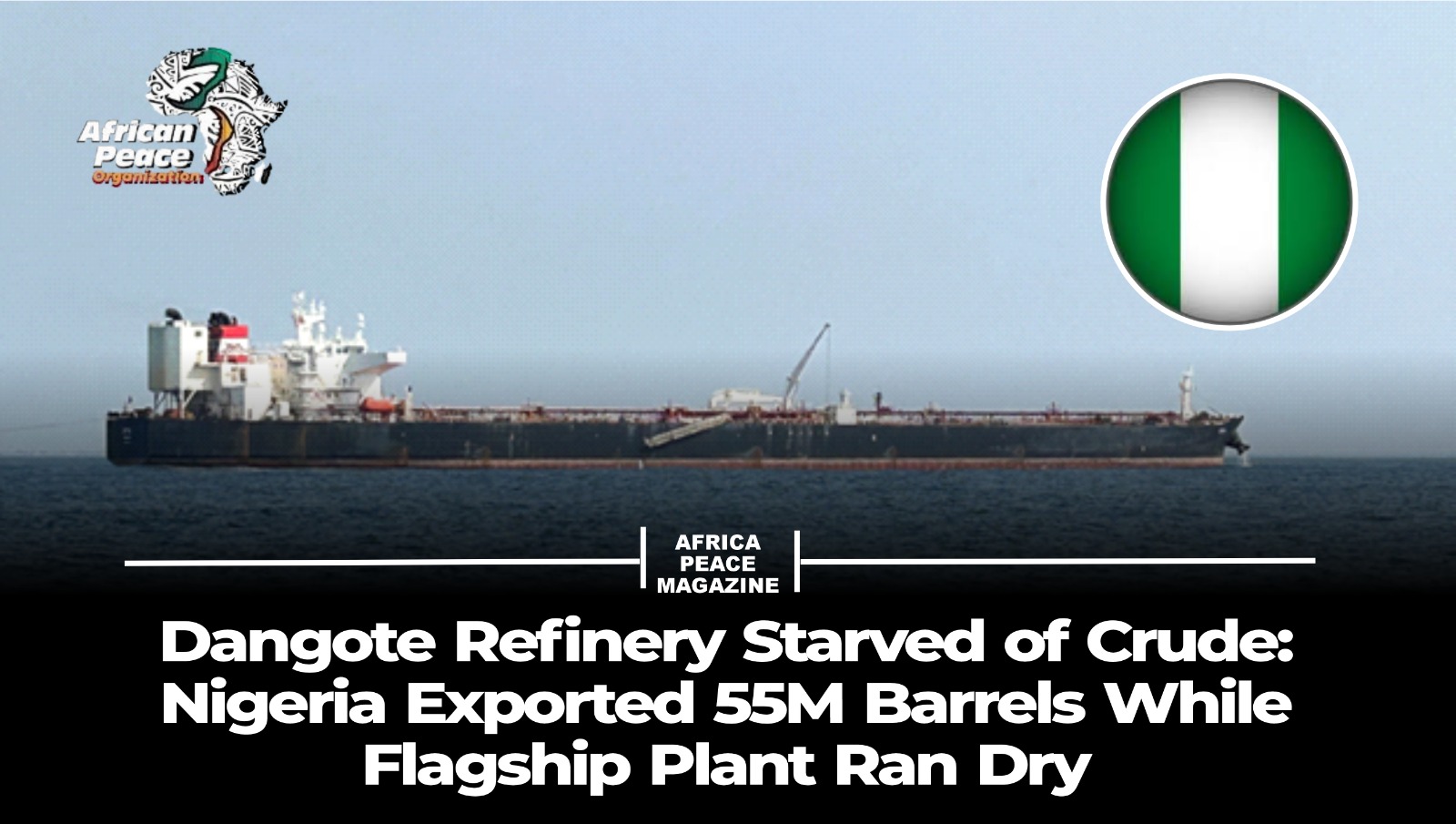
Nigeria exported 55.39 million barrels of crude oil in the first two months of 2026 — even as the $20 billion Dangote Petroleum Refinery in Lekki grappled with a crippling feedstock shortage that left it operating at a fraction of its capacity.
Central Bank of Nigeria data shows the country shipped out 31.31 million barrels in January and 24.08 million barrels in February. In January, crude production averaged 1.46 million barrels per day (mbpd) with exports at 1.01 mbpd. By February, production had slipped to 1.31 mbpd while exports dropped to 0.86 mbpd. Total crude production for the two-month period was 81.94 million barrels — meaning only 26.55 million barrels remained onshore for local refineries.
The 650,000-barrel-per-day Dangote refinery requires approximately 19.77 million barrels of crude monthly to operate at full capacity. But data from a senior management source within the refinery paints a staggering picture of under-supply: the facility received only 4.55 million barrels in October, 6.45 million in November, 4.30 million in December, 5.65 million in January, and 4.66 million in February. In the first half of March, just 3.6 million barrels were delivered.
In total, the refinery received 29.21 million barrels over a five-and-a-half-month stretch ending mid-March — against a requirement of 108.74 million barrels. That is a supply performance of just 26.9 per cent, meaning more than three-quarters of the refinery’s crude needs went unmet.
The refinery has repeatedly complained of receiving far below its required volumes from domestic sources, forcing it to import crude from international markets at a premium. According to the company, it received just five cargoes per month from the Nigerian National Petroleum Company Limited (NNPC), well short of the 13 it requires. The refinery said upstream producers had failed to meet their obligations under the Petroleum Industry Act, which explicitly prohibits the export of crude before domestic demand is satisfied.
“The high crude cost is compounded by the fact that Nigeria’s upstream producers have failed to supply crude oil to the refinery as required under the Petroleum Industry Act, forcing us to source a substantial portion through international traders who charge an additional premium,” the refinery stated.
In response, NNPC said it was leveraging its global crude trading network to source third-party crude for the Lekki plant at competitive international market prices. A senior NNPC source told our correspondent that a shortfall existed but was not deliberate — partly due to some volumes of the company’s daily output having been ‘front-sold’ in the past.
There were signs of improvement in March, when Dangote Group President Aliko Dangote confirmed, via a Bloomberg report, that the refinery received 10 cargoes from NNPC — double its previous monthly average. Six were paid for in naira and four in dollars. Still, this falls short of the over 19 million barrels the refinery needs each month.
The Crude Oil Refiners Association of Nigeria (CORAN) has called for sustained crude supply to local refineries. Its Publicity Secretary, Eche Idoko, noted that modular refineries in particular cannot remain profitable without a consistent feedstock supply. “If we get crude, of course, we will make gains. But without products, we are not making gains,” he said.
Source: The Punch (punchng.com)