

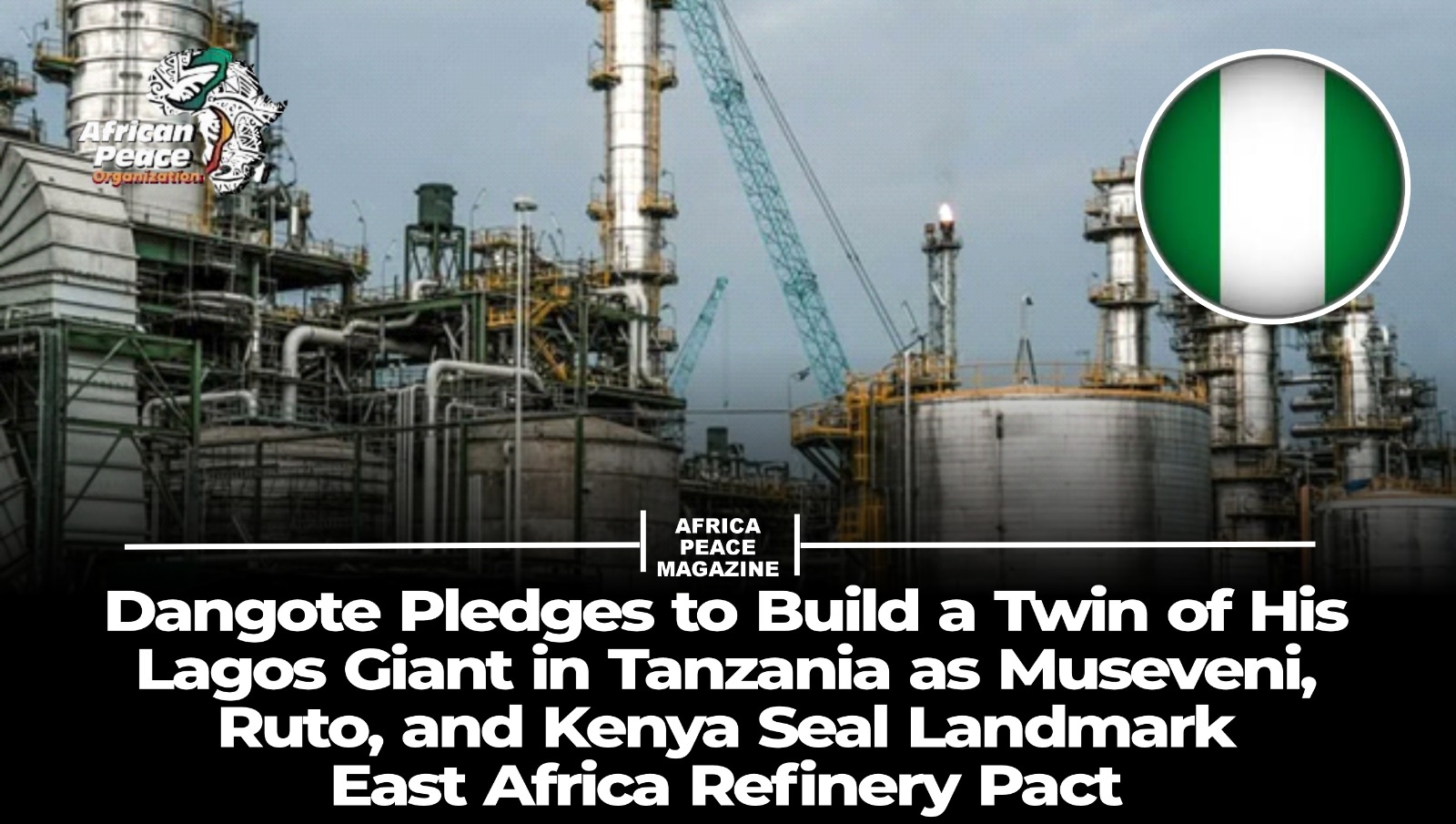
In one of the most consequential energy announcements to come out of East Africa in years, Aliko Dangote — Africa’s richest man and the architect of the continent’s largest oil refinery — has pledged to lead the construction of a 650,000 barrels-per-day refinery in Tanzania’s port city of Tanga, identical in scale to his flagship facility in Lagos. The pledge, made before the presidents of Kenya and Uganda, marks a defining moment in the region’s decades-long push to end its dependence on imported petroleum products.
“I can give commitment to the two presidents. If they will support the refinery, we’ll build the identical one that we have in Nigeria — 650,000 barrels here,” Dangote declared. He struck an unambiguous tone on the project’s viability: “It will work. There’s nothing that can stop it.” His commitment drew resounding applause. He added that construction would be completed within four to five years, with early-stage piling work already underway for what he projects could eventually scale to 1.4 million barrels per day — potentially the largest refinery complex on earth.
Museveni, Ruto, and the EACOP Connection
Uganda’s President Yoweri Museveni set the stage, revealing that President William Ruto had sent him a message proposing that part of Uganda’s crude — currently slated for export via the East African Crude Oil Pipeline (EACOP) to Tanga — could instead serve as feedstock for the new refinery. “So, therefore, when His Excellency Ruto recently sent me a message, I supposed that the surplus oil, which we had given to Total to take through Tanga, to I don’t know where, would be our contribution to the refinery in Tanga,” Museveni said. He confirmed Uganda would retain its separate plan for a domestic 60,000 barrel-per-day refinery at Kabaale in Hoima District, developed with UAE-based Alpha MBM Investments. The Tanzania refinery, by contrast, is conceived as a pan-African project, drawing crude from Uganda, Kenya, South Sudan, and the Democratic Republic of Congo.
Ruto confirmed the vision in concrete terms: “We’re going to have a joint refinery in Tanga to benefit all of us because that refinery is going to take on board the oil from DRC, the oil from Kenya, the oil from South Sudan, and the oil from Uganda.” He pointed to the staggering economics at stake — Africa produces roughly 10 million barrels of oil per day, yet imports 120 million metric tonnes of refined products annually at a cost of approximately $90 billion. Refining domestically and exporting finished products could generate over $500 billion in value, compared to approximately $270 billion from raw crude alone — a potential gain of $230 billion, equivalent to nearly 7.5% of the continent’s GDP.
Kenya to Invest in Uganda’s Domestic Refinery as Cross-Border Integration Deepens
In a parallel move cementing the political architecture underpinning the refinery ambitions, Ruto announced that Kenya will invest in Uganda’s domestic oil refinery — a direct reciprocation of Uganda’s acquisition of a 20.15 per cent stake in the Kenya Pipeline Company (KPC) in February, completed via UNOC at a cost of approximately Shs918 billion. “Mzee, I want to assure you that the same way you invested in Kenya pipeline, Kenya is going to invest in your refinery and in the future of our resources together,” Ruto said.
Dangote framed the East Africa push as part of a wider continental awakening, criticising global financial institutions for historically obstructing African refinery development in favour of preserving export markets. “Normally, when you go to those financial institutions, their interest is not to develop Africa. Their interest is to develop themselves,” he said. He cited his own early financing battles — including a $478 million international loan secured in the early 2000s and repaid ahead of schedule — as proof of African capacity to execute at scale. “It is possible. Africans can do it. Let us not be scared.”
Sources: allafrica.com (multiple reports)