

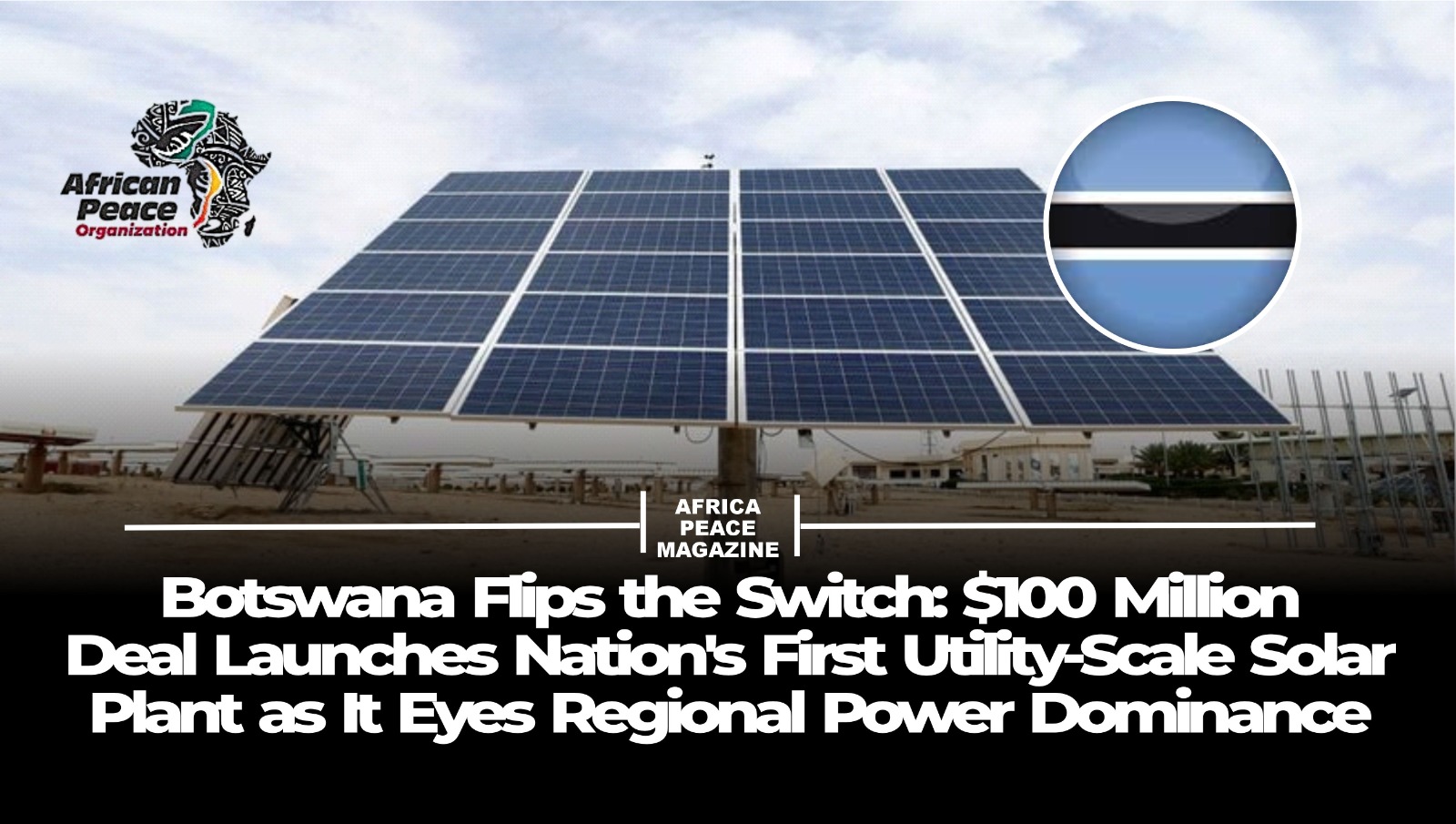
Botswana is stepping boldly into the renewable energy arena, breaking ground on its first utility-scale solar power plant after developers successfully locked in a $100 million financing package — a milestone that could transform the Southern African nation from a power-strapped importer into a regional electricity supplier.
The 100-megawatt Tati Solar Project, developed by Etavi Renewables — a Botswana-based firm partly owned by Shumba Energy Ltd. — is slated to begin commercial operations in 2027. Rand Merchant Bank, a unit of South Africa’s FirstRand Ltd., arranged and underwrote the entire financing structure, positioning the project as a landmark deal in Africa’s evolving renewable energy landscape.
What makes Tati stand out is its market-driven architecture. Rather than supplying a single domestic utility, the plant will sell electricity directly into the Southern African Power Pool (SAPP) — the continent’s most advanced regional electricity trading platform, serving approximately 360 million people across 12 countries with an operating capacity of about 47.7 gigawatts.
Botswana’s push comes at a critical moment. The country has struggled with ageing coal infrastructure, generation shortfalls, and reduced electricity imports from neighbouring South Africa. The Tati project forms part of a broader national strategy to reduce import dependency, diversify generation sources, and carve out a position as a net electricity exporter in a region facing mounting demand pressures driven by population growth, mining activity, data centres, and industrial expansion.
“We found a financing structure that is commercially viable at utility scale for a pure market view into the SAPP,” said Siyanda Mflathelwa, RMB’s Head of Infrastructure Sector Solutions. “That’s great, because it increases the volumes that are now traded on the SAPP day-ahead market.”
The wider southern African region faces compounding energy challenges — drought-weakened hydropower, deteriorating grid infrastructure, and surging electricity demand — making investments in solar and storage increasingly urgent. Similar momentum is visible across the continent: Zambia has leaned on World Bank-backed solar programmes after drought crippled its hydropower, Egypt has attracted African Development Bank financing for a 1-gigawatt solar facility with battery storage, and South Africa has drawn significant private capital following reforms that opened its grid to independent power producers.
Yet the Tati project carries a unique symbolic weight. It represents a growing conviction among financiers that merchant-style renewable energy projects — selling power competitively into regional markets rather than relying on long-term government-backed offtake agreements — can succeed in Africa despite well-documented risks including currency volatility, weak utilities, high borrowing costs, and limited transmission capacity.
“We are beginning to see investors convinced that there is sufficient demand to justify capital investments of this magnitude,” Mflathelwa noted.
If the Tati Solar Project delivers on its promise, it may do more than light up homes across southern Africa — it could fundamentally reshape how renewable energy is financed and traded across the continent.
Source: africa.businessinsider.com