

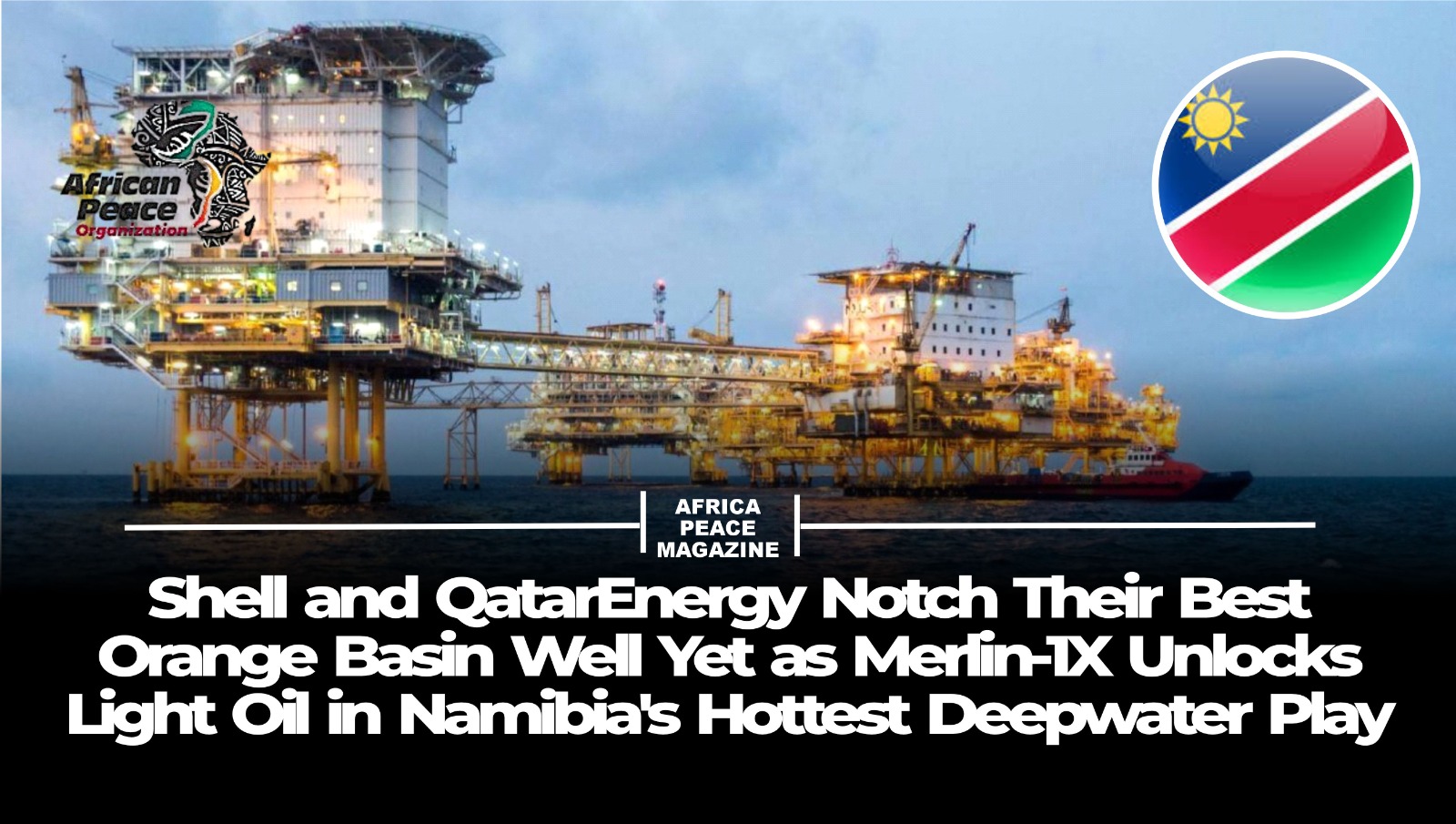
Shell and QatarEnergy have recorded their most technically promising exploration result yet in Namibia’s Orange Basin, with the Merlin-1X well delivering light oil with strong reservoir quality and limited associated gas — a combination the industry regards as commercially favourable and one that meaningfully advances the commercialisation case for the PEL 0039 licence block.
The Merlin-1X well was spudded on April 8, 2026, and is the tenth well drilled within PEL 0039, which is operated by Shell. It successfully penetrated the Coniacian play and returned results that stood apart from the nine wells that preceded it in the licence. QatarEnergy described the outcome as delivering ‘the most promising subsurface results to date’ in the block.
Saad Sherida Al-Kaabi, Qatar’s Minister of State for Energy Affairs and President and CEO of QatarEnergy, described the significance in terms of the broader basin narrative: ‘We are pleased with this discovery, which follows three earlier discovery announcements in Namibia. These results represent a significant step that further strengthens confidence in the Orange Basin as an emerging world-class hydrocarbon province.’ QatarEnergy holds interests in four Namibian offshore licences — PEL 0039 (45%), PEL 0056 (35.25%), PEL 0091 (33.03%), and PEL 0090 (27.5%) — covering a combined area of approximately 34,000 square kilometres.
Shell’s Executive Vice President for Exploration, Eugene Okpere, said the results deepen the company’s read on the basin and support continued evaluation of commercial potential across the licence. He described Shell’s approach as ‘disciplined’ and ‘data-led’ — calibrated to establish commerciality before committing to development capital at scale. Further drilling in 2026 is under active consideration as part of a broader appraisal programme.
The Orange Basin’s transformation from frontier territory to global upstream hotspot since 2022 has been driven by a succession of significant discoveries — TotalEnergies’ giant Venus find, Galp’s Mopane accumulation, and a string of QatarEnergy-partnered hits including Graff-1 and Jonker-1X. Estimated discovered resources in the basin now run into the billions of barrels. Some analysts have drawn comparisons to the early chapters of the Guyana-Suriname story, where a similar sequence of exploration success eventually unlocked one of the decade’s defining deepwater development programmes.
For Namibia, the stakes are transformational. NAMCOR is actively promoting further licensing and preparing infrastructure while the government works to ensure that the country captures long-term national benefit from what could become a generation-defining industry. With first oil from projects like Venus potentially targeted for the 2029 to 2030 timeframe, the Orange Basin is moving — methodically, but unmistakably — from exploration promise toward development reality.
Source: offshore-mag.com | energy-pedia.com