

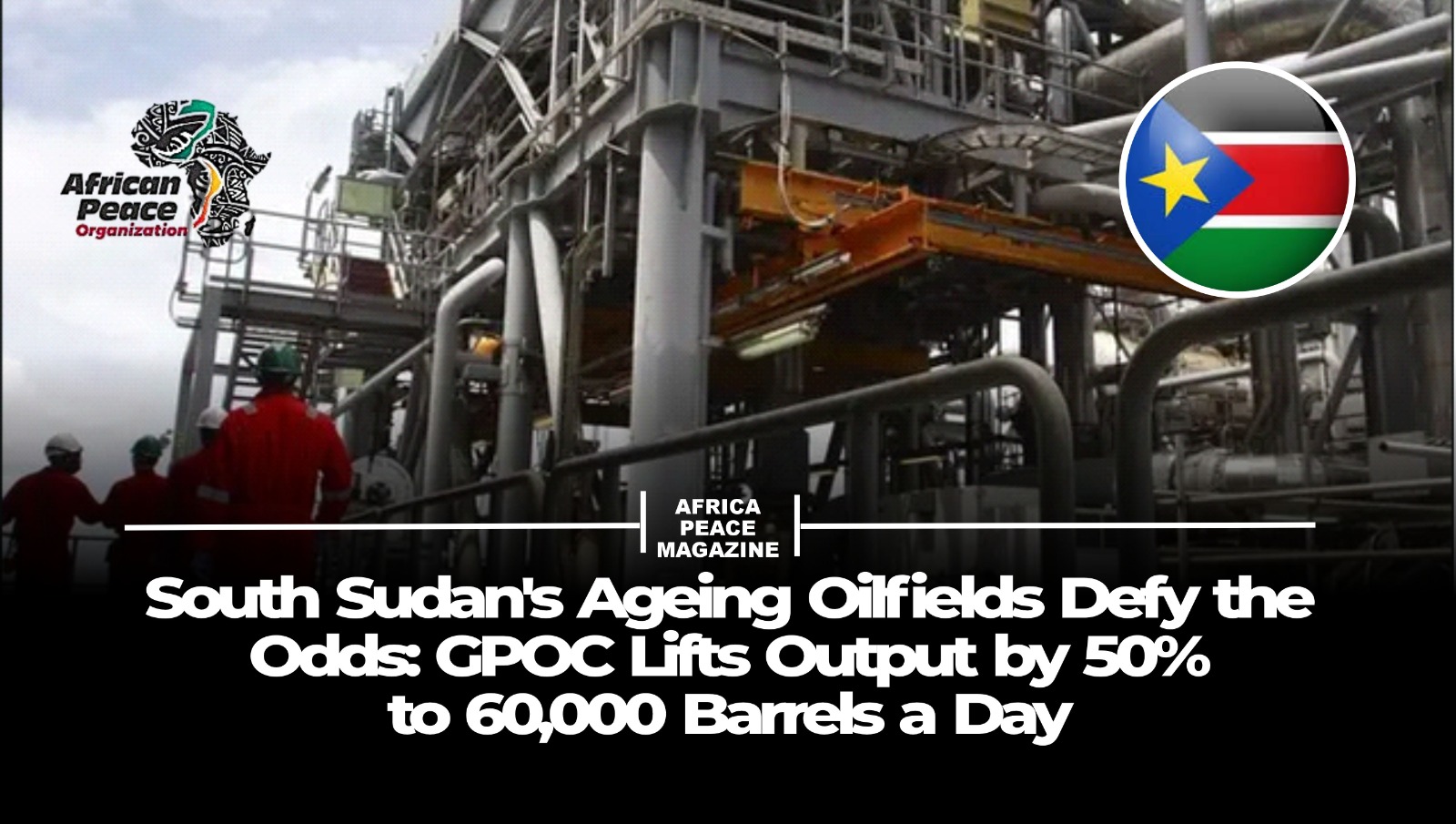
South Sudan’s petroleum sector has recorded a significant production turnaround, with the Greater Pioneer Operating Company lifting output to 60,158 barrels per day from Unity State — up sharply from 40,000 barrels per day — in a development described by government officials as a testament to technical innovation and strategic leadership in one of the world’s most challenging upstream environments.
The milestone was announced by Petroleum Ministry Undersecretary Dr. Santino Ayuel Longer at a ceremony held in Juba to honour GPOC President He Yanhui, whose leadership was credited with reversing a prolonged decline in production from fields that have been operating for nearly three decades. “Today we celebrate not merely a production milestone, but a testament to vision, resilience, innovation, and professional excellence,” Dr. Ayuel said.
The achievement is particularly striking given the natural depletion pressures facing GPOC’s blocks. Dr. Ayuel noted that mature oil fields of this type typically experience natural decline rates of approximately 25 per cent annually — a trajectory that would ordinarily see output fall rather than rise. The turnaround was achieved through residual oil recovery studies, fast-track field development strategies and innovative production enhancement programmes that collectively reversed the decline and generated new growth. Newly developed infrastructure contributed more than 6,171 barrels per day to current output alone.
Director General for Petroleum Exploration and Production, Eng. Lual Chol Dak, provided a fuller picture of the country’s total production. With GPOC’s 60,000 barrels per day from Blocks 1, 2 and 4 in Unity State, DAR Petroleum producing 100,000 barrels per day from Blocks 3 and 7 in Paloch, and SPOC operating at 14,000 barrels per day in Tharjath, South Sudan’s total national output now stands at 174,000 barrels per day. “We are moving ahead to improve production beyond this,” Chol Dak said.
GPOC President He Yanhui said the focus now shifts to sustaining current levels while pressing for further growth. “We are trying to sustain the current production by using all our talent to endure all risks in the oil fields. We are trying our best to create thinking, creativity, and technology to increase our international assistance,” he said.
The production recovery carries particular economic weight for South Sudan, a country where oil revenues account for the overwhelming bulk of government income. Output once exceeded 300,000 barrels per day following independence in 2011 before collapsing due to civil conflict, insecurity and ageing infrastructure. The latest figures, while still well below those peak levels, represent a meaningful step toward rebuilding an industry central to the country’s economic survival.
Source: radiotamazuj.org