

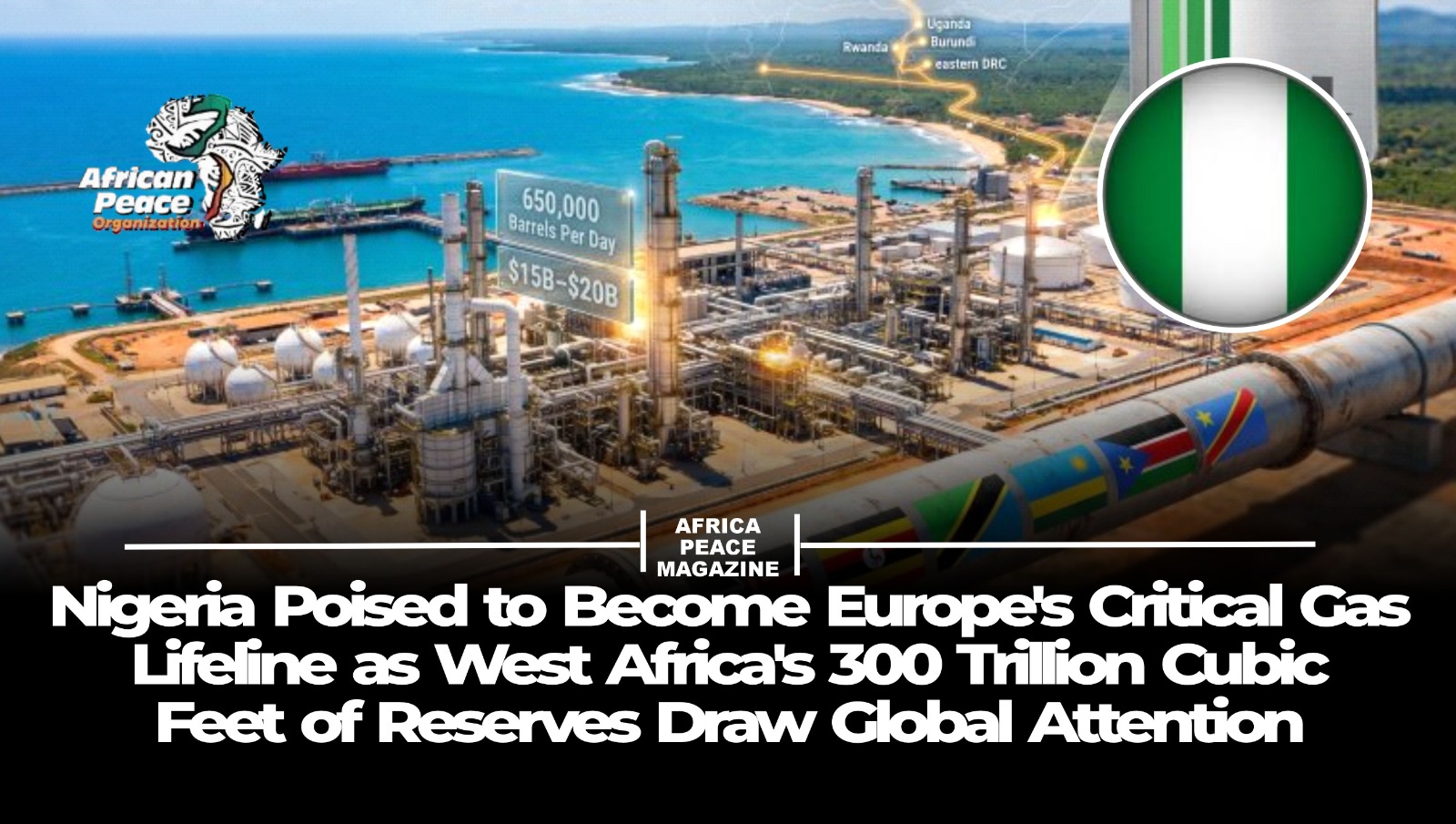
Nigeria is increasingly being positioned as a cornerstone of Europe’s long-term energy diversification strategy, with Africa’s most gas-rich nation holding an estimated 211 trillion cubic feet of proven gas reserves and possessing the infrastructure and geographic advantage to supply European markets at a scale that could meaningfully reduce the continent’s dependence on a narrow set of suppliers.
Africa already supplies around 20 per cent of Europe’s gas needs through Nigerian and Mauritanian LNG in the west, Algerian and Libyan pipelines in the north, and Mozambican LNG in the east — a share that is growing as new LNG corridors emerge in Senegal, Côte d’Ivoire, and Angola. Nigeria currently accounts for approximately 5 per cent of European Union LNG imports, but analysts say the country holds the reserves and production growth potential to become a significantly larger supplier.
Nigeria’s gas export infrastructure includes the West African Gas Pipeline, which feeds into the Nigeria-Morocco Gas Pipeline (NMGP), and the proposed Trans-Sahara Gas Pipeline, which would link into Algeria’s TransMed network to Italy. This dual-track export logic aims to position Nigeria as both a regional gas hub and a pivotal actor in Africa’s clean energy transition — with the NMGP, in particular, viewed as a route that bypasses existing North African chokepoints and diversifies European supply across geographies that do not share common vulnerability triggers.
The Economic Community of West African States collectively holds more than 300 trillion cubic feet of proven gas reserves, with the bulk concentrated in Nigeria. Other notable West African producers include Côte d’Ivoire, Ghana, and Senegal. Analysts note that West African states possess a tangible geographic advantage over more distant suppliers — their proximity to Europe translates directly into lower transport costs and shorter supply chains, strengthening the commercial case for long-term supply partnerships.
However, analysts caution that Europe’s energy partnership interest in West Africa must be structured carefully to avoid reproducing the extractive patterns that have historically stifled development across the region. Prioritising export volumes over domestic energy access risks creating new dependencies while deepening energy poverty at home. Nigeria itself, despite holding vast gas reserves, continues to struggle with chronic domestic energy shortages. Analysts argue that any durable partnership must align European demand with African developmental interests — including domestic energy access, industrialisation, and local value addition — rather than treating African energy simply as a procurement solution to European supply constraints.
Source: orientalnewsng.com