

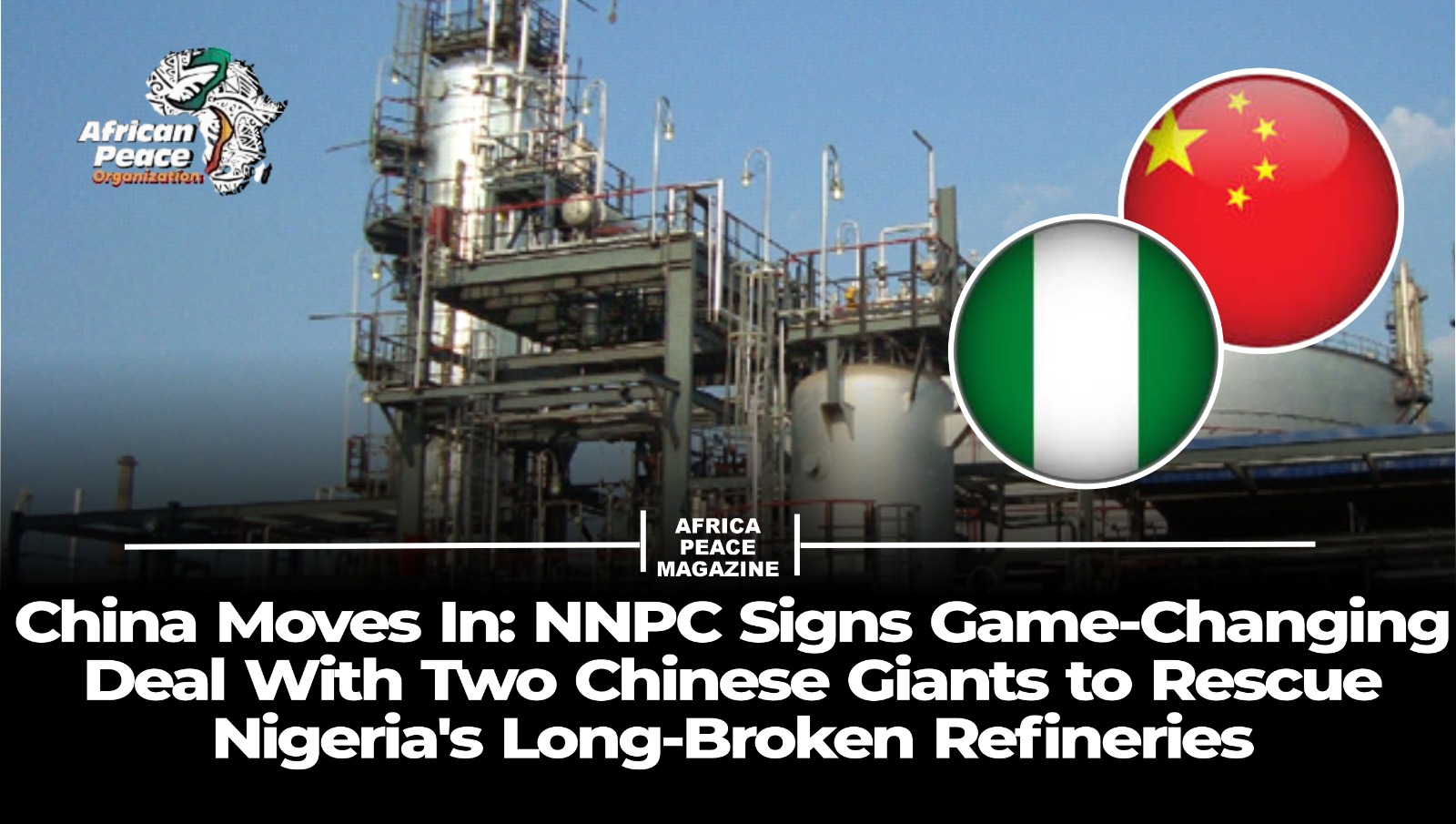
In a pivotal shift away from decades of failed contractor-led rehabilitation, the Nigerian National Petroleum Company Limited has signed a Memorandum of Understanding with two Chinese firms — Sanjiang Chemical Company Limited and Xingcheng (Fuzhou) Industrial Park Operation and Management Co. Ltd — to revive, operate, and expand the country’s long-crippled Port Harcourt and Warri refineries, which together hold a combined refining capacity of 335,000 barrels per day.
The agreement was signed in Jiaxing City, China, on April 30, 2026, by NNPC Group Chief Executive Officer Bashir Bayo Ojulari, Sanjiang Chemical Chairman Guan Jianzhong, and Xingcheng Chairman Bill Bi. The MoU sets the stage for a potential Technical Equity Partnership — a model that NNPC describes as a deliberate departure from traditional turnaround maintenance agreements that have repeatedly consumed billions of dollars without delivering lasting results. Under the proposed framework, the Chinese partners would not only bring engineering expertise but also operational discipline and investment capital, with their financial returns tied directly to the performance of the refineries.
The scope of the collaboration is sweeping in ambition. Beyond completing outstanding rehabilitation work, the partnership would cover full operation and maintenance of both facilities to achieve what NNPC called ‘best-in-class, sustainable performance.’ The arrangement would also pursue expansion and upgrade projects designed to bring the refineries into compliance with cleaner fuel standards, improve product quality, raise profitability, and boost petrochemical production capacity. Crucially, it also contemplates the development of co-located gas-based industrial hubs around the Port Harcourt and Warri complexes — a vision that would transform them from standalone fuel processors into integrated energy and petrochemical centres capable of monetising Nigeria’s vast gas reserves and supporting export-oriented industries.
Ojulari described the deal as the outcome of more than six months of intensive technical and commercial negotiations and framed it as a fundamental shift in how Nigeria approaches its chronic refinery challenge. “The days of spending billions on rehabilitation without sustainable output are behind us. We are now focused on partnerships that deliver value, technology transfer, and operational excellence,” he said. “What we are doing differently is moving away from just funding projects to bringing in partners who have skin in the game — partners who will operate, optimise, and guarantee performance.” He added that refineries must evolve into integrated industrial platforms encompassing petrochemicals, fertilisers, and gas monetisation — a model he described as the only path to creating real economic value.
The two Chinese companies bring distinct but complementary capabilities to the table. Sanjiang Chemical, a Hong Kong Stock Exchange-listed firm headquartered in Zhejiang Province and established in 2003, is one of China’s leading integrated petrochemical producers, operating one of the world’s largest single-unit chemical processing facilities and specialising in ethylene oxide, ethylene glycol, polypropylene, butadiene, methanol derivatives, and industrial gases. Xingcheng, based in Guangdong Province, is an industrial park development and management company with expertise in infrastructure development, industrial ecosystem creation, and investment facilitation — skills directly applicable to building the gas-based industrial hubs NNPC envisions around the refinery sites.
The Port Harcourt Refining Company, with a design capacity of 210,000 barrels per day, has been under a $1.5 billion rehabilitation contract since 2021 — awarded to Italy’s Saipem among others — but was shut down again on May 24, 2025 for maintenance and a sustainability assessment, barely six months after briefly resuming operations in late 2024. The Warri Refining and Petrochemical Company, targeting 125,000 barrels per day, is under a separate rehabilitation contract valued at approximately $897 million. Both facilities have suffered decades of underperformance and repeated rehabilitation failures that have left Nigeria — Africa’s largest oil producer — overwhelmingly dependent on imported petroleum products. NNPC stressed that while the MoU reflects a shared commitment to advance discussions in good faith, any binding agreements remain subject to regulatory approvals and the conclusion of detailed commercial negotiations.
Source: Vanguard Nigeria | Punch Nigeria