

In a landmark assertion of resource sovereignty, Niger has concluded new memoranda of understanding with China National Petroleum Corporation (CNPC) that fundamentally reshape the terms under which the world’s third-largest oil company operates in the country — all without resorting to nationalisation or expulsion.
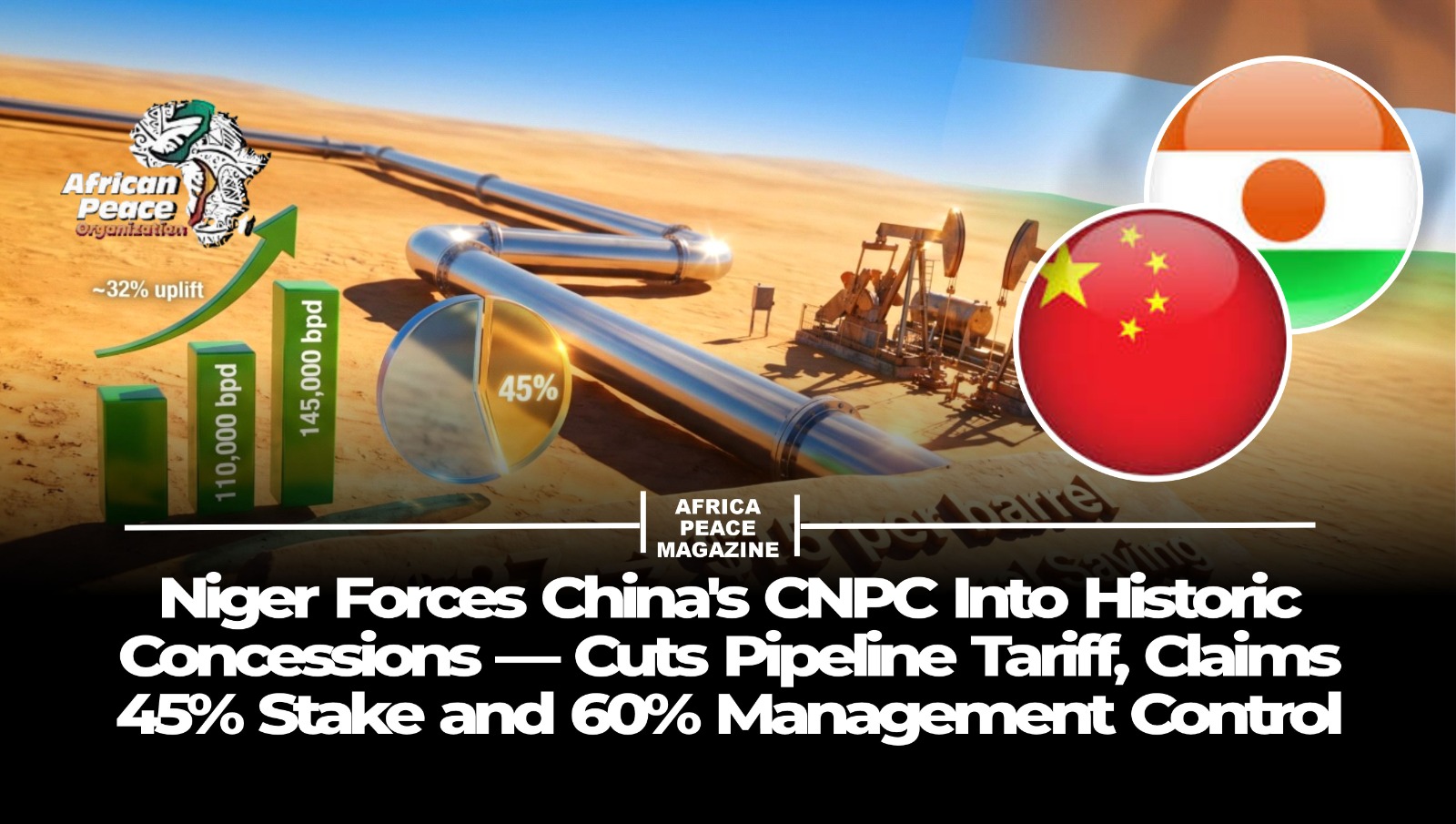
The agreements, signed on May 18, 2026, represent the culmination of more than a year of tense negotiations between Niamey and Beijing and deliver a package of sweeping concessions to the Nigerien state. Under the new terms, Niger will acquire a 45 per cent stake in West African Oil Pipeline Company (WAPCO), CNPC’s local subsidiary. The share of management positions held by Nigeriens will rise sharply from 30 per cent to 60 per cent, and 80 per cent of all operational jobs will be reserved for national workers.
The most immediately impactful clause is a dramatic reduction in the pipeline transport tariff — slashed from $27 to $15 per barrel — generating an estimated $106 million in annual savings for the Nigerien state. For a country whose total government revenue is estimated at under $2 billion per year, the saving is material.
The breakthrough comes as Niger’s oil production stabilises at 110,000 barrels per day following the 2024 commissioning of the 1,950-kilometre Niger-Benin pipeline, which gave the landlocked country its first direct export route to the Atlantic coast. Niger used the leverage of that pipeline dependency — CNPC needs the route to export its production — to extract equity, employment and tariff concessions while keeping the partnership intact.
Analysts say the approach is being closely watched across the region. In Chad, oil sector unions have already publicly called for replicating Niger’s model, which they view as more favourable to national interests than existing arrangements. The dynamic is part of a broader continental trend of resource-producing states demanding larger shares of extractive revenues — one that has accelerated markedly since 2022 as military-led governments in the Sahel have moved to assert control over strategic industries.
Niger is now pressing toward a fuller energy value chain. Projects under active development include a refinery in Dosso, strategic storage facilities, fuel production covering jet fuel and LPG, natural gas processing, and the Trans-Saharan Gas Pipeline connecting Nigeria to Algeria via Niger — a route designed to supply European markets. Around 70 per cent of national territory comprises sedimentary basins, with eight oil blocks covering more than 240,000 square kilometres still available for exploration.
Source: allafrica.com