

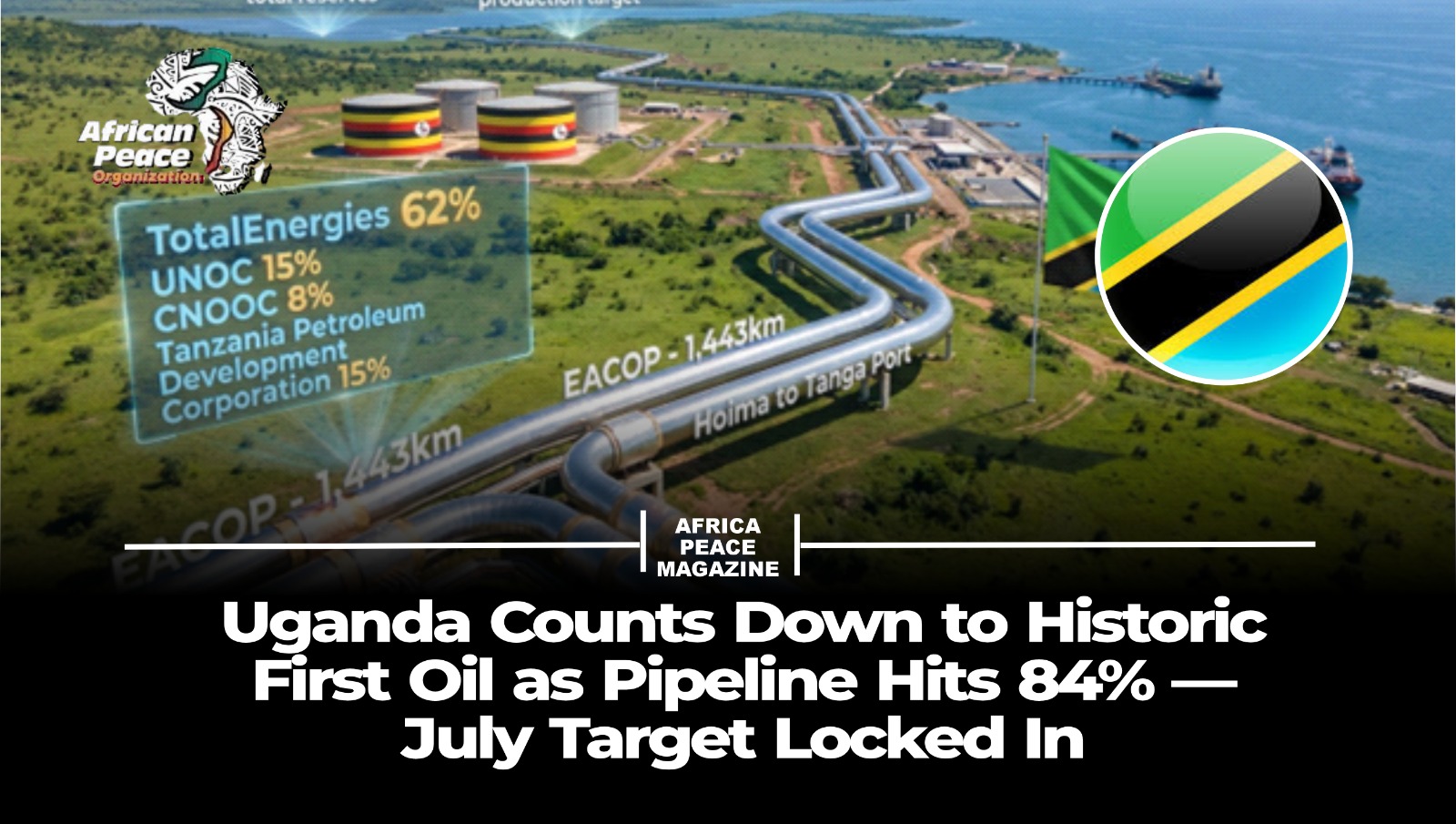
Uganda is on the cusp of a landmark moment in its economic history, with the East African Crude Oil Pipeline (EACOP) now 84% complete and the country firmly targeting first oil production in July. The announcement came as the government simultaneously launched the National Petroleum Policy 2025 — a sweeping new framework designed to govern the sector as it transitions from infrastructure build-out to full commercial production.
EACOP Deputy Managing Director John Bosco Habumugisha confirmed that key technical components have already been delivered, including the Tilenga feeder line, installation of marine loading arms for transferring crude into vessels, and insulation of crude oil tanks to maintain optimal temperatures. Current work is concentrated on completing the piping systems required to transport and process crude oil. “We made a commitment to deliver the pipeline this year and we will not stop until it is done,” Habumugisha declared.
The pipeline, stretching 1,443 kilometres from Kabale, Hoima in Uganda to Tanga on Tanzania’s coast, is expected to carry over 60,000 barrels per day once production begins — at a moment when global oil prices remain under pressure from geopolitical tensions. Habumugisha added that the workforce has crossed 4,000 people across EACOP staff and subcontractors, with expatriate roles increasingly being handed over to trained Ugandan nationals. According to Uganda’s Petroleum Directorate, the project is projected to generate 14,000 direct jobs, 45,000 indirect jobs, and 105,000 induced employment opportunities in the long run.
Minister of Energy and Mineral Development Dr. Ruth Nankabirwa framed the milestone in historic terms. “For more than two decades, Uganda has undertaken a disciplined journey — from exploration to appraisal, from uncertainty to clarity. Today, the question is no longer if we will produce oil, but when and how well we will manage it,” she said. Deputy Speaker Thomas Tayebwa echoed the sentiment, describing the oil sector as a “strategic inflection point” and calling on Parliament to ensure that petroleum revenues are managed with transparency and accountability. “This is how oil becomes a blessing, not a curse,” he said.
The National Petroleum Policy 2025, which replaces the 2008 framework, is built around nine pillars — including expanding exploration, strengthening downstream supply, promoting value addition, enforcing environmental standards, and improving transparency. It also introduces more flexible licensing regimes, combining competitive bidding with direct applications, to attract new investment. Government data presented at the 11th Oil and Gas Convention in Kampala showed that TotalEnergies’ Tilenga project has drilled over 145 wells, CNOOC’s Kingfisher project is approximately 70% complete, and Kabalega International Airport — a key logistics hub — is over 90% complete.
TotalEnergies Country Chair Philippe Groueix stressed that the sector is shifting from a capital expenditure-driven construction phase to an operations-driven economy expected to sustain production for 20 to 30 years. “We are moving from building infrastructure to operating it. This is where real value will be created — through technology transfer, long-term contracts, and the growth of Ugandan enterprises,” he said. Ugandan firms have already secured contracts worth over $300 million through local content policies, with more expected as the sector matures. A planned $4 billion refinery, alongside petrochemical, fertiliser, and LPG industries, is expected to anchor value addition and reduce dependence on imports. The government has also reaffirmed its commitment to carbon neutrality by 2050, arguing that oil revenues will fund renewable energy investments that prepare Uganda for the global energy transition.
Source: AllAfrica.com