

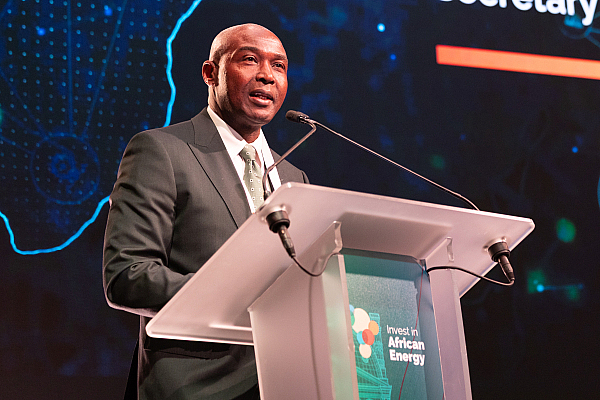
Delays to new gas projects and continued underinvestment in upstream development are raising the prospect that global LNG markets will remain tighter for longer than previously expected, industry leaders said at the opening of the Invest in African Energy Forum in Paris on Wednesday.
The discussion was shaped by a shared concern: that shifting geopolitics, capital discipline and deferred final investment decisions (FIDs) are converging to slow new supply just as demand continues to evolve.
Gas Exporting Countries Forum (GECF) Secretary General Dr. Philip Mshelbila said the market had been widely expected to tip into oversupply by 2026, but that outlook is now being reassessed as volatility persists and investment timelines stretch.
“The current energy crisis touches every corner of the globe,” he said, pointing to sustained disruption driven by geopolitical tensions and supply uncertainty. If instability continues, he added, the market risks a more structural reordering rather than a near-term correction.
That uncertainty is already feeding through into investment decisions, with companies increasingly prioritizing risk management over expansion, leading to deferred FIDs across several gas developments.
For Africa, the implications are particularly acute. Despite holding significant gas reserves and export infrastructure – including LNG capacity and pipeline links to Europe via Libya and Algeria – much of the continent’s potential remains constrained by weak upstream development.
“There is a material gap between capacity and reserves, and actual production,” Mshelbila said, stressing that closing that gap will require sustained and large-scale upstream investment. He estimated global gas investment needs at $11–12 trillion over the coming decades, with the majority directed toward exploration and production.
That investment gap is also being felt further down the value chain. Anibor Kragha, Executive Secretary of the African Refiners and Distributors Association (ARDA), pointed to Africa’s continued dependence on imported refined products and limited strategic buffers, exposing structural fragility across the downstream sector.
“Africa remains heavily dependent on refined petroleum products,” he said, noting that some countries operate with as little as 20 days of strategic fuel reserves. “We’ve come to realize how fragile the global supply chain is.”
He argued that addressing these vulnerabilities will require a rethink of refinery development models, with future projects needing to be more flexible and integrated in order to attract long-term capital.
NJ Ayuk, Executive Chairman of the African Energy Chamber, framed the broader energy debate around rising demand rather than transition, arguing that Africa is entering a period of structural energy expansion driven by industrial growth and emerging technologies.
“We believe Africans deserve more, not less energy,” he said, describing the coming decade as “an African decade of energy additions, not energy transitions.”
Ayuk pushed back against what he described as disproportionate global climate narratives around Africa, noting that the continent contributes less than 3% of global emissions. “No other industry has matched our industry’s ability to produce more energy with fewer emissions,” he said.
Ayuk also highlighted accelerating demand from new sectors, including data infrastructure and artificial intelligence, which he said will require “historic amounts of new energy,” reinforcing the need to accelerate gas development and monetize existing discoveries.
Rounding out the discussion, Foday Mansaray, Director General of Sierra Leone’s Petroleum Directorate, emphasized that project delivery will depend increasingly on alignment between governments, investors and operators, particularly in frontier markets.
“The future of energy is being negotiated in rooms like this,” he said, underscoring the importance of partnership-driven development as Africa seeks to convert resources into production.
Distributed by APO Group on behalf of Energy Capital&Power.